Since we started ten years ago we have always kept our price rises to the absolute minimum because making our clothes as affordable as possible has always been a fundamental principle. Our second fundamental principle has always been fair rates for our factory partners and fair wages for all, especially those making our clothes.
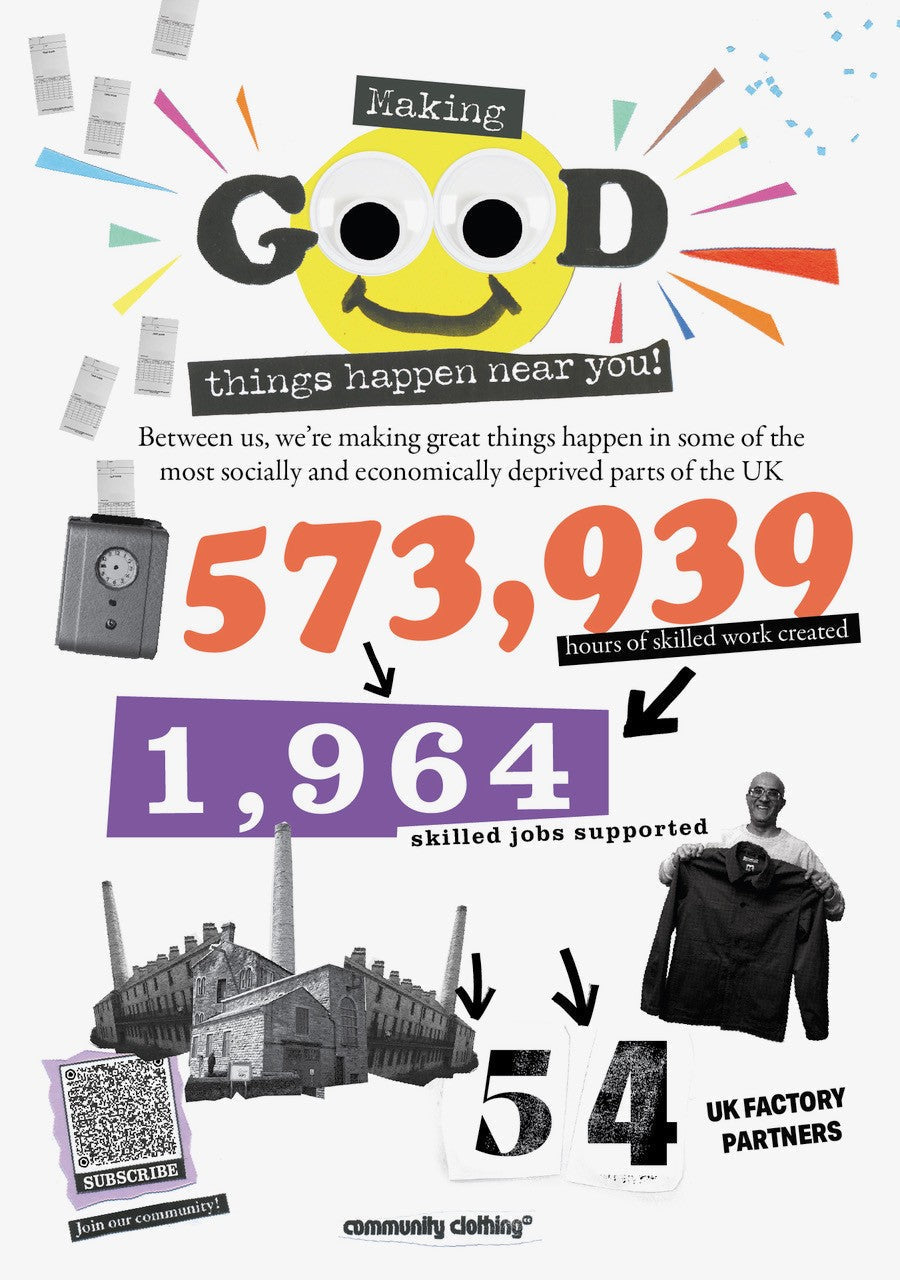
Where your money goes is important, and it can have a fantastically positive impact across our society. When you shop with us over 95p in every pound stays in the UK economy (and in some products, like our British wool knitwear every penny stays here).
To make this work we have to work incredibly efficiently, with a very lean team. Out of every pound you spend with us we give about 65p to our factories (vs about 20p for other brands), and 18p goes to the VAT man, leaving us with not very much at all to design, buy, market, sell, warehouse and distribute our product. We are just 14 people, 10 of whom are part time (we're 43% working mums). Most parts of our business have just one person in them, the exceptions being customer service and production which each have two. We are made up of highly efficient doers not managers, with very modest salaries to boot. This is also important. The ratio of highest paid to lowest paid workers within businesses is an important measure of its social good. For example, the lowest paid garment workers in Bangladesh get the equivalent of just $720 a year. Compare that to the salaries of some of the highest paid clothing execs, like the CEO of H&M on $2,700,000, CEO of Zara on $6,600,000, or the CEO of M&S on $9,500,000 a year - over 13,000 times the lowest paid. Is this right? For comparison, as the boss of Community Clothing I am paid just 2.2 times the lowest wage of the people making our clothes. We believe a fair division of the economic pie will make our society better for all of us.
But making in the UK, paying fairly and running a very lean business does mean when costs in the UK rise, our costs do too. In the ten years we’ve been going energy prices for UK businesses have almost tripled, the UK minimum wage has close to doubled, insurance costs are rising by double digit percentages every year, and (happily for anyone who loves the British countryside) wool prices have more than doubled in the past 5 years (they went up 20% in 2025 alone!). Over the years our prices haven’t quite kept pace with costs (happily for you the customer), but if we’re going to have the long term positive social and environmental impact we want to have our business needs to be on a sound, economically sustainable, footing.
Our prices are going up. The lowest increases will be about 4%, the average with be around 10% and for a few products, where we have seen the biggest cost rises, prices will go up by almost 15%. However, I can still say put my hand on my heart and tell you that every single item we sell represents exceptional value for money. To get clothes of this quality from anyone else would set you back at least twice, and in lots of cases three, four or even five times as much. We’re proud of the clothes we make, and we’re proud too of the honest way we do business.
Price rises will come into effect from Midnight on Monday 9th of March so you’ve more than ten days to beat the increases if there is anything you need.

Since we started ten years ago we have always kept our price rises to the absolute minimum because making our clothes as affordable as possible has always been a fundamental principle. Our second fundamental principle has always been fair rates for our factory partners and fair wages for all, especially those making our clothes.
Where your money goes is important, and it can have a fantastically positive impact across our society. When you shop with us over 95p in every pound stays in the UK economy (and in some products, like our British wool knitwear every penny stays here).
To make this work we have to work incredibly efficiently, with a very lean team. Out of every pound you spend with us we give about 65p to our factories (vs about 20p for other brands), and 18p goes to the VAT man, leaving us with not very much at all to design, buy, market, sell, warehouse and distribute our product. We are just 14 people, 10 of whom are part time (we're 43% working mums). Most parts of our business have just one person in them, the exceptions being customer service and production which each have two. We are made up of highly efficient doers not managers, with very modest salaries to boot. This is also important. The ratio of highest paid to lowest paid workers within businesses is an important measure of its social good. For example, the lowest paid garment workers in Bangladesh get the equivalent of just $720 a year. Compare that to the salaries of some of the highest paid clothing execs, like the CEO of H&M on $2,700,000, CEO of Zara on $6,600,000, or the CEO of M&S on $9,500,000 a year - over 13,000 times the lowest paid. Is this right? For comparison, as the boss of Community Clothing I am paid just 2.2 times the lowest wage of the people making our clothes. We believe a fair division of the economic pie will make our society better for all of us.
But making in the UK, paying fairly and running a very lean business does mean when costs in the UK rise, our costs do too. In the ten years we’ve been going energy prices for UK businesses have almost tripled, the UK minimum wage has close to doubled, insurance costs are rising by double digit percentages every year, and (happily for anyone who loves the British countryside) wool prices have more than doubled in the past 5 years (they went up 20% in 2025 alone!). Over the years our prices haven’t quite kept pace with costs (happily for you the customer), but if we’re going to have the long term positive social and environmental impact we want to have our business needs to be on a sound, economically sustainable, footing.
Our prices are going up. The lowest increases will be about 4%, the average with be around 10% and for a few products, where we have seen the biggest cost rises, prices will go up by almost 15%. However, I can still say put my hand on my heart and tell you that every single item we sell represents exceptional value for money. To get clothes of this quality from anyone else would set you back at least twice, and in lots of cases three, four or even five times as much. We’re proud of the clothes we make, and we’re proud too of the honest way we do business.
Price rises will come into effect from Midnight on Monday 9th of March so you’ve more than ten days to beat the increases if there is anything you need.

|
2025 was a year of some pretty amazing numbers for Community Clothing, but there are two that mean more than all the others. Read Patrick's New Year Impact Update |

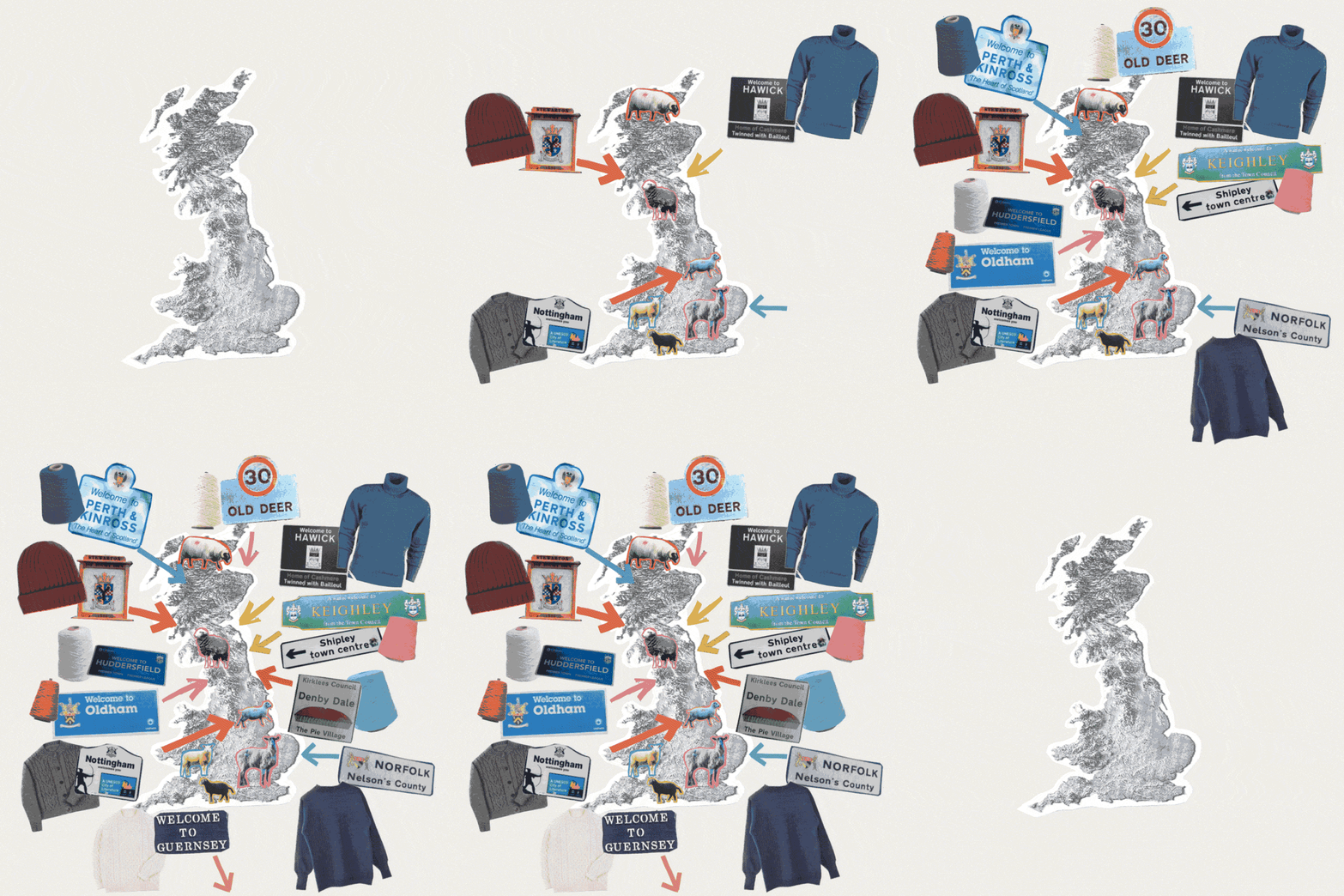
Maybe it’s because we’ve been into wool for at least six thousand years? Or maybe it’s because whilst pretty much everyone else on the planet switched to trying to make the cheapest clothes they could, we stuck to trying to make the best ones.